Ebook Download Causal Inference for Statistics, Social, and Biomedical Sciences: An Introduction
Yet, how is the means to get this publication Causal Inference For Statistics, Social, And Biomedical Sciences: An Introduction Still confused? It matters not. You could enjoy reviewing this book Causal Inference For Statistics, Social, And Biomedical Sciences: An Introduction by online or soft documents. Merely download and install the publication Causal Inference For Statistics, Social, And Biomedical Sciences: An Introduction in the link provided to see. You will obtain this Causal Inference For Statistics, Social, And Biomedical Sciences: An Introduction by online. After downloading and install, you could save the soft documents in your computer or gadget. So, it will certainly alleviate you to review this e-book Causal Inference For Statistics, Social, And Biomedical Sciences: An Introduction in certain time or area. It might be uncertain to delight in reading this publication Causal Inference For Statistics, Social, And Biomedical Sciences: An Introduction, because you have great deals of task. However, with this soft data, you could enjoy reviewing in the spare time also in the spaces of your tasks in workplace.
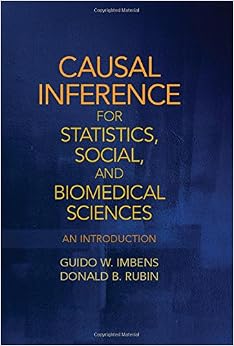
Causal Inference for Statistics, Social, and Biomedical Sciences: An Introduction

Ebook Download Causal Inference for Statistics, Social, and Biomedical Sciences: An Introduction
Do you require brand-new reference to accompany your spare time when being at residence? Reading a book can be a good selection. It can spare your time usefully. Besides, by checking out book, you can enhance your understanding as well as experience. It is not just the scientific research or social understanding; many points can be acquired after reading a publication.
As we mentioned before, the technology assists us to consistently recognize that life will certainly be consistently easier. Reviewing e-book Causal Inference For Statistics, Social, And Biomedical Sciences: An Introduction behavior is likewise one of the benefits to obtain today. Why? Modern technology can be made use of to provide guide Causal Inference For Statistics, Social, And Biomedical Sciences: An Introduction in only soft documents system that can be opened every time you really want and almost everywhere you require without bringing this Causal Inference For Statistics, Social, And Biomedical Sciences: An Introduction prints in your hand.
When you want to review it as part of tasks at home or workplace, this file can be likewise kept in the computer or laptop. So, you could not have to be worried about losing the published publication when you bring it someplace. This is among the most effective reasons that you need to choose Causal Inference For Statistics, Social, And Biomedical Sciences: An Introduction as one of your reading materials. All very easy way shades your tasks to be easier. It will certainly also lead you in making the life runs far better.
When providing Causal Inference For Statistics, Social, And Biomedical Sciences: An Introduction as one of the collections of several publications right here, we assume that it can be one of the most effective publications listed. It will have several fans from all nations readers. And precisely, this is it. You could really reveal that this book is just what we assumed initially. Well currently, allow's seek for the various other publication title if you have actually got this book review. You could find it on the search column that we provide.
Review
"This book offers a definitive treatment of causality using the potential outcomes approach. Both theoreticians and applied researchers will find this an indispensable volume for guidance and reference." Hal Varian, Chief Economist, Google, and Emeritus Professor, University of California, Berkeley"By putting the potential outcome framework at the center of our understanding of causality, Imbens and Rubin have ushered in a fundamental transformation of empirical work in economics. This book, at once transparent and deep, will be both a fantastic introduction to fundamental principles and a practical resource for students and practitioners. It will be required readings for any class I teach." Esther Duflo, Massachusetts Institute of Technology"Causal Inference sets a high new standard for discussions of the theoretical and practical issues in the design of studies for assessing the effects of causes - from an array of methods for using covariates in real studies to dealing with many subtle aspects of non-compliance with assigned treatments. The book includes many examples using real data that arose from the authors' extensive research portfolios. These examples help to clarify and explain many important concepts and practical issues. It is a book that both methodologists and practitioners from many fields will find both illuminating and suggestive of further research. It is a professional tour de force, and a welcomed addition to the growing (and often confusing) literature on causation in artificial intelligence, philosophy, mathematics and statistics." Paul W. Holland, Emeritus, Educational Testing Service"A comprehensive and remarkably clear overview of randomized experiments and observational designs with as-good-as-random assignment that is sure to become the standard reference in the field." David Card, Class of 1950 Professor of Economics, University of California, Berkeley"This book will be the "Bible" for anyone interested in the statistical approach to causal inference associated with Donald Rubin and his colleagues, including Guido Imbens. Together, they have systematized the early insights of Fisher and Neyman and have then vastly developed and transformed them. In the process they have created a theory of practical experimentation whose internal consistency is mind-boggling, as is its sensitivity to assumptions and its elaboration of the key 'potential outcomes' framework. The authors' exposition of random assignment experiments has breadth and clarity of coverage, as do their chapters on observational studies that can be readily conceptualized within an experimental framework. Never have experimental principles been better warranted intellectually or better translated into statistical practice. The book is a "must read" for anyone claiming methodological competence in all sciences that rely on experimentation." Thomas D. Cook, Joan and Sarepta Harrison Chair of Ethics and Justice, Northwestern University, Illinois"In this wonderful and important book, Imbens and Rubin give a lucid account of the potential outcomes perspective on causality. This perspective sensibly treats all causal questions as questions about a hidden variable, indeed the ultimate hidden variable, "What would have happened if things were different?" They make this perspective mathematically precise, show when and to what degree it succeeds, and discuss how to apply it to both experimental and observational data. This book is a must-read for natural scientists, social scientists and all other practitioners who seek new hypotheses and new truths in their complex data." David Blei, Columbia University"This thorough and comprehensive book uses the "potential outcomes" approach to connect the breadth of theory of causal inference to the real-world analyses that are the foundation of evidence-based decision making in medicine, public policy and many other fields. Imbens and Rubin provide unprecedented guidance for designing research on causal relationships, and for interpreting the results of that research appropriately." Mark McClellan, Director of the Health Care Innovation and Value Initiative, Brookings Institution, Washington DC"This book will revolutionize how applied statistics is taught in statistics and the social and biomedical sciences. The authors present a unified vision of causal inference that covers both experimental and observational data. They do a masterful job of communicating some of the deepest, and oldest, issues in statistics to readers with disparate backgrounds. They closely connect theoretical concepts with applied concerns, and they honestly and clearly discuss the identifying assumptions of the methods presented. Too many books on statistical methods present a menagerie of disconnected methods and pay little attention to the scientific plausibility of the assumptions that are made for mathematical convenience, instead of for verisimilitude. This book is different. It will be widely read, and it will change the way statistics is practiced." Jasjeet S. Sekhon, Robson Professor of Political Science and Statistics, University of California, Berkeley"Clarity of thinking about causality is of central importance in financial decision making. Imbens and Rubin provide a rigorous foundation allowing practitioners to learn from the pioneers in the field." Stephen Blyth, Managing Director, Head of Public Markets, Harvard Management Company"A masterful account of the potential outcomes approach to causal inference from observational studies that Rubin has been developing since he pioneered it fourty years ago." Adrian Raftery, Blumstein-Jordan Professor of Statistics and Sociology, University of Washington
Read more
Book Description
Many applied research questions are fundamentally questions of causality: Is a new drug effective? Does a training program affect someone's chances of finding a job? What is the effect of a new regulation on economic activity? In this ground-breaking text, two world-renowned experts present statistical methods for studying such questions.
Read more
See all Editorial Reviews
Product details
Hardcover: 644 pages
Publisher: Cambridge University Press; 1 edition (April 6, 2015)
Language: English
ISBN-10: 0521885884
ISBN-13: 978-0521885881
Product Dimensions:
7.3 x 1.3 x 10.3 inches
Shipping Weight: 2.9 pounds (View shipping rates and policies)
Average Customer Review:
3.8 out of 5 stars
13 customer reviews
Amazon Best Sellers Rank:
#238,182 in Books (See Top 100 in Books)
Some people are of the opinion that statistics should replace calculus in high school/college curricula because of the importance of analytics in the modern business world. I think a similar argument could be made about replacing some of the more esoteric parts of graduate statistics/econometrics with causal inference theory. If that opinion is correct, this would be an excellent reference text.Causal inference theory is important because the regression techniques now taught to young social scientists as methods of determining cause and effect assume endogeneity when the data often don't support such an assumption. They also impose a linear model on the data that can be similarly inappropriate. The non-parametric techniques discussed by Rubin and Imbens, while having their own assumptions, are applicable to a wider range of problems.Rubin and Imbens summarize the voluminous literature on propensity score and related causal inference techniques in a manner that is accessible to someone with a solid background in statistics (both frequentist and Bayesian). I read the book cover to cover and, despite already knowing something about Propensity Score techniques, learned a great deal.They begin with randomized experiments then explain how the mathematical models developed for such methods are also applicable to observational studies. They then discuss various methods of using the Propensity Score along with tests of the plausibility of such models and bias limits when some of the assumptions in these models are relaxed.One complaint I have is that the different types of exact matching are barely discussed. Considering the growing importance of techniques like Coarsened Exact Matching, this seems like a significant oversight. In addition, the book contains no exercises making it difficult to use as a textbook without some supplementary material.All in all, though, this work is a must have for those engaged in Causal Inference either academically or in the business world. Even those not making active use of these techniques might find applications to their empirical work once they understand how to properly use Propensity Score analysis.
This book does not have a very rigorous approach to causation. The applied parts are lacking as well -- they apply the suggested models in “empirical examples†but that's literally it - they just run the models and read the numbers, no insightful interpretation of anything, no justification and so on. If you want to read something informal but applied, go to Mostly Harmless Econometrics by Angrist and Pischke. If you want to read something rigorous, go to Causality by Judea Pearl.
I really love it.
The only shortcoming is that font is small. If the margin is reduced to give more space to the context, that would be perfect!
A great book. It has careful and easy (to follow) arguments that help to understand interestign situations.
Although this might be a good book to study causal inference since there are not many choices for now, it was tediously long in many topics. I wish it were written in a more concise way.
Recommended strongly by Prof. Strauss, really the best!
Imbens & Rubin are masters.
Causal Inference for Statistics, Social, and Biomedical Sciences: An Introduction PDF
Causal Inference for Statistics, Social, and Biomedical Sciences: An Introduction EPub
Causal Inference for Statistics, Social, and Biomedical Sciences: An Introduction Doc
Causal Inference for Statistics, Social, and Biomedical Sciences: An Introduction iBooks
Causal Inference for Statistics, Social, and Biomedical Sciences: An Introduction rtf
Causal Inference for Statistics, Social, and Biomedical Sciences: An Introduction Mobipocket
Causal Inference for Statistics, Social, and Biomedical Sciences: An Introduction Kindle
Causal Inference for Statistics, Social, and Biomedical Sciences: An Introduction PDF
Causal Inference for Statistics, Social, and Biomedical Sciences: An Introduction PDF
Causal Inference for Statistics, Social, and Biomedical Sciences: An Introduction PDF
Causal Inference for Statistics, Social, and Biomedical Sciences: An Introduction PDF

This post was written by: Author Name
Your description comes here!

Posting Komentar